Saturday, March 9, 2013

The resurrection of the US amphibious warfare fleet

A new and illustrative naval vessel was christened this week in San Diego. The USNS Montford Point, the first of the US Navy’s three planned Mobile Landing Platforms (MLP), was built by General Dynamics and is designed to obviate the need for large deepwater ports in amphibious operations.

The christening of the Montford Point, largely unremarked on in the mainstream press, is an illustration of the US Navy’s growing focus on amphibious and special operations capabilities. While the new Ohio-class submarine or the new Ford-class aircraft carriers get most of the attention, recent actions by the US Navy suggest it is also intent on restoring amphibious capabilities that stagnated somewhat thanks to 10 years of war in Iraq and land-locked Afghanistan.

The primary capability of the Montford Point is to provide a platform to distribute vehicles and equipment directly onto landing craft, particularly the LCAC hovercraft and its eventual replacement. The main deck is designed to be lowered below water level, by taking on ballast, so that LCAC can drive right onto it to pick up cargo. Instead of an interior ‘well deck’ found on many amphibious ships, the whole ship is essentially a well deck. In conjunction with a new logistics system, this class will replace the need for an amphibious force to take control of a major port–a difficult task which can become a vulnerable bottleneck.

The MLP class comes on the heels of the deployment last year of the USS Ponce, a retrofitted amphibious warfare ship now designed as a helicopter carrier, special operations platform, and, reportedly, a UAV base. Alongside the new America-class of assault ships (the first is to be commissioned this year) that provide large helicopter landing facilities, these vessels emphasize the US military’s aim of being able to have a strong presence anywhere in the world, without the need for expensive and controversial land basing. In addition, these platforms improve the ability of the United States’, particularly the Marine Corps, ability to deploy anywhere at short notice with a combined arms force while at the same time reducing replenishment concerns.

As Brett Friedman has demonstrated in the Journal of Military Operations’, the fact that the US is unlikely to mount a full scale amphibious assault in the near future does not mean amphibious operations are nonexistent, or even rare. Indeed, amphibious operations run the gamut from the purely humanitarian (the US Navy was able to immediately respond to both the Haiti earthquake in 2010 and the Japanese tsunami in 2011) to the military (support of the NATO Libya campaign) to everything in between (such as seabasing for counter-terror operations against Abu Sayyaf in the Philippines). Particularly as Western populace’s support for large ground operations diminishes and as budget cuts take effect, the ability to support operations from the sea for a relatively small cost is a great advantage.

Despite a focus in Washington on AirSea Battle and the expected rise of China to a near-peer competitor, it is these smaller missions that will, and should, continue to occupy the bulk of American naval and Marine Corps operations. While ‘big ticket’ items like aircraft carriers and ballistic missile submarines are important for the US’s strategic posture, it is ships like the Ponce, the Montford Point and the America that will be called upon to deliver disaster relief, support allied operations, and, if needed, become the tip of the spear for limited operations.


Cross posted at World Outline

The resurrection of the US amphibious warfare fleet

A new and illustrative naval vessel was christened this week in San Diego. The USNS Montford Point, the first of the US Navy’s three planned Mobile Landing Platforms (MLP), was built by General Dynamics and is designed to obviate the need for large deepwater ports in amphibious operations.

The christening of the Montford Point, largely unremarked on in the mainstream press, is an illustration of the US Navy’s growing focus on amphibious and special operations capabilities. While the new Ohio-class submarine or the new Ford-class aircraft carriers get most of the attention, recent actions by the US Navy suggest it is also intent on restoring amphibious capabilities that stagnated somewhat thanks to 10 years of war in Iraq and land-locked Afghanistan.

The primary capability of the Montford Point is to provide a platform to distribute vehicles and equipment directly onto landing craft, particularly the LCAC hovercraft and its eventual replacement. The main deck is designed to be lowered below water level, by taking on ballast, so that LCAC can drive right onto it to pick up cargo. Instead of an interior ‘well deck’ found on many amphibious ships, the whole ship is essentially a well deck. In conjunction with a new logistics system, this class will replace the need for an amphibious force to take control of a major port–a difficult task which can become a vulnerable bottleneck.

The MLP class comes on the heels of the deployment last year of the USS Ponce, a retrofitted amphibious warfare ship now designed as a helicopter carrier, special operations platform, and, reportedly, a UAV base. Alongside the new America-class of assault ships (the first is to be commissioned this year) that provide large helicopter landing facilities, these vessels emphasize the US military’s aim of being able to have a strong presence anywhere in the world, without the need for expensive and controversial land basing. In addition, these platforms improve the ability of the United States’, particularly the Marine Corps, ability to deploy anywhere at short notice with a combined arms force while at the same time reducing replenishment concerns.

As Brett Friedman has demonstrated in the Journal of Military Operations’, the fact that the US is unlikely to mount a full scale amphibious assault in the near future does not mean amphibious operations are nonexistent, or even rare. Indeed, amphibious operations run the gamut from the purely humanitarian (the US Navy was able to immediately respond to both the Haiti earthquake in 2010 and the Japanese tsunami in 2011) to the military (support of the NATO Libya campaign) to everything in between (such as seabasing for counter-terror operations against Abu Sayyaf in the Philippines). Particularly as Western populace’s support for large ground operations diminishes and as budget cuts take effect, the ability to support operations from the sea for a relatively small cost is a great advantage.

Despite a focus in Washington on AirSea Battle and the expected rise of China to a near-peer competitor, it is these smaller missions that will, and should, continue to occupy the bulk of American naval and Marine Corps operations. While ‘big ticket’ items like aircraft carriers and ballistic missile submarines are important for the US’s strategic posture, it is ships like the Ponce, the Montford Point and the America that will be called upon to deliver disaster relief, support allied operations, and, if needed, become the tip of the spear for limited operations.


Cross posted at World Outline

Thursday, March 7, 2013

Sulu standoff in Malaysia threatens peace treaty amid growing violence

My first article for World Outline, a news and analyst website run by former KCL War Studies folk. Check out their website.

The standoff between Sulu fighters and security forces in Malaysia has worrying implications for both Malaysian politics and a peace deal in the Philippines.

In a story that has largely escaped the attention of the western news media, the standoff between Sulu raiders and Malaysian police is now affecting relations between the two countries, the Malaysian political climate, and the success of a vital peace treaty in the Philippines.

Since the group of approximately 100 ‘invaders’ from the Sulu archipelago arrived near the Sabah town of Lahad Datu in early February, they have been surrounded by Malaysian security forces. However, since a failed raid last week, violence has become a recurring theme and between 27 and 31 people have been killed thus far.

Arriving by speedboat nearly four weeks ago, Jamalul Kiram III and his followers occupied a village, claiming part of Sabah territory for the Sultan of Sulu and his heirs. Several of the group claim to be the Sultan’s descendants. While only the latest chapter in a long-running dispute over who rightfully controls the region, this attempt to take Sabah by force is a new and unwelcome development. The violence began late last week when the Malaysian police attempted to storm the village. Two security officers and twelve of the Sulu fighters were killed in the firefight that ensued. Then, on Saturday, a group of Malaysian troops were apparently ambushed, while in a separate incident several more Sulu fighters were killed – bringing the death toll to approximately 20.

The fighting continued on Sunday and there have been reports that hostages have subsequently been taken. However, several of the news reports contradict each other and there is – as yet – little agreement on the exact number of people killed. Nevertheless, what is clear is that the situation has deteriorated dramatically and is causing wider problems for both the Malaysian and Philippine governments.

Malaysian Prime Minister Najib Razak is required to call elections before the end of June and these events have thrown the campaign into disarray. The opposition has capitalised on the attack as proof of lax border security and the inability of the current government to protect Malaysians.

There are also an estimated 800,000 Filipinos living legally in Sabah who are facing a potential backlash. These concerns have caused the Philippines’ Foreign Secretary to fly to Malaysia in an effort to urge ‘maximum tolerance’ between the two populations.

Even more worryingly, across the straits the delicate peace agreement between the Filipino government and the Moro Islamic Liberation Front has been put at risk. After initial conciliatory statements, President Aquino last week called on the Sulu fighters to surrender ‘without conditions’. The Moro leader Murad Ebrahim responded by accusing the president of throwing fellow Filipino Muslims to the ‘Malaysian wolves’. Neither side has yet suggested delaying the final peace treaty, but the conclusive end of a 30+ year conflict is being put at risk by continued violence.

There is little doubt that the Malaysian security forces will eventually retake control of the villages and expel the remaining Sulu fighters. How it is done, and how long it takes, however, remains to be seen. The Malaysian government can little afford delays their perceived ability to protect Malaysian borders and the residents of Sabah, but a bloodbath is in no one’s interest and would fuel dangerous tensions between Sabah’s Malaysian and Filipino populations.

Finally, although the Philippine peace treaty is likely to be finalized, a bad ending to the standoff greatly increases the possibility of a breakaway group that would reject the deal. Much as the Islamic Liberation Front did 30 years ago when they broke away from the Moro National Liberation Front, this group would continue the insurgency in the Philippine archipelago, affecting Malaysia and the Philippines alike. That is a result all parties would do well to avoid.

Sunday, February 10, 2013

Thinking about the Straits of Hormuz


Commander Dolan’s May 2012 Proceedings article suggests that the US Navy should respond to potential Iranian aggression in the Straits of Hormuz from a distance, engaging the Iranian navy in the Arabian Sea and IRGC assets in the Persian Gulf from over-the-horizon. He argues that Iranian A2/AD capabilities are such that, in order to conserve the force, the US should not contest the Straits and littoral waters directly; the US navy should instead position its forces to wear down and defeat Iran’s assets from afar. This strategy would potentially mean surrendering control the straits to Iranian forces for a brief period of time but, he argues, would safeguard US ships and provide a more certain method of defeating the Iranians.

While Commander’s Dolan’s ideas are provocative, his analysis does not deal comprehensively with Iran’s most potent capabilities which are difficult, if not impossible, to deal with from a distance.  In addition, if Iran were to close the Straits, even temporarily, alternative oil routes need to be found—and options are limited. While the Habshan-Fujairah pipeline does allow some Emirati oil to bypass the straits, its capacity is less than 9% of the Straits’ daily traffic. Given the limitations of alternative routes, the US navy has focused on confronting the Iranians within the Straits. This brief analysis outlines major Iranian capabilities and the deployments the US has made in an attempt to counter them.

Iran’s primary force in any Straits-closure attempt would be the Iranian Republican Guard Corps Navy utilizing mines, small boats (both torpedo and missile craft), and land-based anti-ship missiles. The Iranian Navy only operates outside the Gulf and poses a significantly smaller threat. Dolan’s article focuses primarily on IRGC-N’s missile threat and, accurately, articulates a standoff strategy to defeat it. The US navy would position guided missile ships and carrier-based planes in the North Arabian Sea to counter land, air, and sea-launched Iranian missiles. However, this strategy only deals with the most vulnerable third of Iran’s assets.

Mine warfare could cause havoc in the constricted space of the straights, particularly among merchant vessels. The US Navy is aware of this threat and has deployed 8 of its 14 Mine Counter-Measure (MCM) ships to Bahrain. Additionally, IMCMEX12, the region’s largest ever naval exercise, is currently underway with 30 national navies working together to practice MCM techniques. However, US MCM ships are approximately 20 years old and are limited in number. Their supposed replacement, the Littoral Combat Ship with an MCM unit, has yet to be deployed. Thus, though any attempt by IRGC-N to lay mines would result in the US Navy quickly sinking the mine-laying ships, the resulting minefield would still necessitate a weeks-long clearing process.

 The threat of IRGC small-boat-swarming tactics, armed with both anti-ship missiles and torpedoes, is an equally worrisome issue. These small craft, ranging from inshore patrol boats to coastal fast attack craft, are generally armed with anti-ship missiles (many of Chinese origin) or torpedoes. The US Navy’s response has been the forward deployment of 5 Cyclone-class patrol boats at Manama, with an additional 5 thought to be sent forward within the last 6 months. The US Coast Guard also maintains a permanent presence of 6 patrol boats in Bahrain. However, given the IRGC-N is thought to have anywhere between 75-150 small craft, the US presence is certainly not decisive and could find themselves overwhelmed by sheer numbers. Finally, Iran operates a series of submarines (Qadir-class mini sub and several Russian built Kilo class). US Navy ASW abilities suggest that smaller Qadir-class is the more potent threat to Gulf shipping. However, their short range and questionable combat effectiveness would likely limit their operations to the coastal waters of Iran.

Any attempt by Iran to close the Straits would, therefore, be a combined operation of surface ships utilizing missiles and torpedoes, land-based anti-ship missiles and a mine-laying campaign. This three-pronged approach creates difficulties for a US Navy that has focused on standoff weaponry and large, expensive, high-capability ships. However, this asymmetric conflict design does not mean the US Navy cannot regain the initiative.  By utilizing both existing MCM and patrol ships assets alongside over-the-horizon capabilities, the US can puts itself in the best position to deny Iran the ability to close the Straits.

Standoff weaponry, including carrier-borne aircraft, should be positioned in the Arabian Sea to confront IRIN assets outside the Straits, destroy IRGC-N missile systems, and provide air cover and ASW capabilities inside the Gulf. Meanwhile, MCM ships and USN/USCG patrol boats, alongside helicopter MCM from Bahrain, would be assigned the mission of dealing with IRGC-N small boats and mines. There would likely be losses within this latter group (US Navy simulations in 2011 suggested swarming tactics could sink up to 16 US ships in the Gulf). However, if the US is to remain a guarantor of the free flow of commerce in the region, it must demonstrate a willingness to take on Iran directly and prevent closure of the Straits. This two-pronged response to Iranian aggression allows the US Navy to use its standoff advantages to defeat Iranian A2/AD and static capabilities while at the same time offering an in-situ defense against small boats, mine-laying and ship-borne missile attacks. Maintaining the free flow of commerce through the Straits in the face of Iranian aggression is both extraordinarily important and difficult. For this reason, the US rightly dedicates significant assets both inside and outside the Gulf to ensure Iran is not able to halt the flow of oil.

Saturday, September 22, 2012

What explains the lack of LeT 'spectacular' attacks given the success of their 2008 Mumbai operation?

Accounting for the lack of Lashkar-e-Taiba (LeT) attacks on India since 2008 requires evaluation of several analytical levels, namely organizational, state and international. There are two clusters of reasons for LeT’s lack of attacks: first, internal LeT dynamics that have affected the group’s operational choices and, second, pressure applied by, and to, Pakistan’s ISI. The second set of reasons is dominant given the ISI’s influence and strength. A further contributing factor is the improvement of Indian counter-terrorism, particularly regional intelligence hubs and the new National Investigation Agency, though these advancements are certainly not determining factors.

The 2008 Mumbai assault was a departure in size, though not in style, from previous LeT activities. The group’s fidayeen attacks, begun in July 1999, generally involved 2-4 gunmen, meaning Mumbai was a significantly larger operation. American LeT operative David Headley’s plea deal indicates the shift was due to internal LeT politics, notably the need to retain control of and inspire younger, more extreme members, who were increasingly focused on Afghanistan rather than LeT’s traditional Kashmiri-centric area of operations. This explains the decision to increase the attack’s size during the final preparations. Mumbai should, therefore, be seen as a one-off ‘spectacular’ designed to reinvigorate the group and enhance its cohesion. It was not the beginning of a large-scale fidayeen offensive. In addition, by 2008 LeT had shifted its focus to concentrate on supporting and financing the Indian Mujahideen (IM) group. LeT was instrumental in setting up IM and supporting its bombing campaign but has never had operational control. LeT support for IM has continued, most notably with the 2010 Pune bombing.

LeT’s ideology, the final internal dynamic, suggests it sees further terrorism in India as counterproductive. LeT promotes Ahl-e-Hadith Islam and its ideology minimizes intra-Muslim conflict while concentrating on attacking non-believers. It is, therefore, supportive of Pakistani national integrity, which would come under serious threat if further Mumbai-like attacks occurred. This position was elucidated by Hafiz Saeed, leader of LeT’s charitable arm Jama’at- ud-Da’wah. He said that although LeT wants change within the Pakistani state, Pakistan is a defender of Muslims and thus LeT will not do anything that could damage the country. It is relatively unsurprising, therefore, that LeT has not implemented a major terrorist assault in India since 2008 because neither its organizational goals, ideology nor current strategy suggest it requires one.

LeT’s internal dynamics arguing against further terrorism in India complement the external forces dictating the group’s actions. Pakistan’s ISI and Military Intelligence have always maintained significant influence over the group due to their similar recruiting areas in Punjab; the fact that the government built the group’s military capabilities throughout the 1990s for use as a proxy force; and the suspected fact that the ISI maintains case officers for important LeT operatives. In addition, the ISI has guided the LeT’s organizational evolution in order to allow the group’s continued operation while providing Pakistan with plausible deniability. Pakistan’s security services possess, therefore, a high level of control over LeT activities and operations; indeed, David Headley has claimed that his ISI handler, a Major Iqbal, was aware of the Mumbai targets and assisted operational planning.

After the Mumbai attacks, the US and India, along with the international community, put significant pressure on the Pakistani government to crack down on Kashmir-focused militant groups. American pressure in particular forced Pakistan to create a new strategy for its relationship with LeT. According to regional expert Anatol Lieven, author of the new book Pakistan: A Hard Country, and others, the new Pakistani strategy has been to ensure LeT does not attack either India or the West while at the same time retaining its ties with the group and ensuring it maintains its military capabilities. This approach has allowed Pakistan to maintain both its proxy force and needed international relationships. The Pakistani government and LeT understand that striking India in the short-term would damage Pakistani national interests and could provoke a full-scale war. The LeT and Pakistani security forces have been allies for 20 years because of this confluence of ideological and strategic viewpoints. It is this shared view, combined with the influence applied by the ISI, that accounts for the lack of LeT attacks in India since 2008. 

Wednesday, August 15, 2012

Militarization of America: A work in progress?

Earlier this week Dan Trombly and InkSpotsGulliver had an interesting back and forth on the usage of the term militarization to describe America's ever-increasing reverence of the military. It was prompted by a letter in protest of NBC's new piece of horrendous reality television 'Stars Earn Stripes'. While Trombly and Gulliber's discussion was mostly about whether the term militarization was a good place-holder for a more complex process, one that both described as 'fetishization of the military', the question raises a broader point about the expansion of militaristic ideas and processes within American society and what exactly woud constitute militarization. 

In my mind there is little question that 'fetishization of the military' has become a cultural norm over the last decade or so. There are a wide variety of indicators, several of which are touched on in a few posts by Jason Fritz over at Ink Spots. Perhaps the one that's gotten the most attention is the Stolen Valor Act, which, while prohibiting a very distasteful action, ran roughshod over first amendment protection of expression no matter how vile. Other recent instances would include the political argument over early voting in Ohio and the aforementioned television show. 

However, while it is silly to suggest these data points represent the militarization of American culture, Keith Boyea made a very good point on twitter suggesting that fetishization of the military would like precede actual militarization. With that in mind, it is worth considering a few other changes to US culture over the last several years that point to an increasingly weaponized and military-minded America. Whether they represent outright militarization is difficult to say and for what it's worth I don't think it does--yet. 

One of the most obvious shifts in America's weaponization has been the purchase by local police departments of ever-heavier weaponry and vehicles. I'm not talking about major, or even small, cities investing in SWAT-like units, which I see as completely reasonable. I'm discussing small town police departments where there are often no more than a few dozen officers, if that, but they still have vehicles suitable to operations in Afghanistan (are MRAPs really needed on the small-town streets of America?) and where the standard sidearm carried by officers is supplanted by assault weapons. This shift towards a police force that resembles more of a para-military force in appearance (though obviously not in action or creed) would suggest America is an increasingly unsafe place reliant on authority's possession of heavy weaponry to keep the peace. That's, to put it mildly, not a positive trend.

Obviously much of the increased firepower found in small-town police departments is a response to the increasing power of the weaponry available to civilians and, therefore, criminals. However, the end of the gun control battle (for all intents and purposes the NRA won when Senator Ron Johnson said high capacity magazines were a constitutional right) is also a sign of America's shift toward a weaponized culture. The complete lack of restriction on gun purchases and gun ownership has meant Americans are more heavily armed than ever. More worryingly, however, is the slow disintegration of the background check culture that allows people like disturbed individuals like James Holmes or white supremacists like Wade Page (who the FBI was already aware of) to get their hands on a high-powered and perfectly legal arsenal. When the crazies can get legal guns it's unsurprising that law-abiding citizens want the ability to protect themselves via concealed weapons and that the police demand heavier weapons. Without some sensible restrictions on gun purchases (I see no reason why a 24-hour waiting period/background check shouldn't be instituted. Whoever needs a gun 'right now' probably shouldn't be getting one) America's gun possession stats will continue to rise right alongside the number of gun-related deaths each year. 

The final indicator of America's more gun-happy culture is a foreign policy-related one (as an IR guy, there had to be an international touch to this....). Increasingly America does not have a foreign policy it has a military policy. Budgets are often cited to demonstrate this (State's total budget is something like 10% of the Pentagon's base budget) but it goes deeper than that. Americans now see interactions with other states primarily through the lens of military action. The idea of drawn out diplomatic and economic wrangling is seen as both ineffective and not American enough. This is a problem among elites as well as the mass population and on the right as on the left. Calls for military action in both Syria and Iran point to America's view of military force as a fix-all when generally it is anything but. This is a cultural shift and is part of the fetishization of the military discussed above but has weakened US diplomats and diplomacy.

These are merely observations of how America has shifted over the last ten years or so towards a more weaponized society, one that sees the individual ability to deliver physical violence as a net plus, and views American strength solely in terms of military power. While America is certainly not a militarized society, are these not some of the characteristics that one might expect of a society on the road to militarization?


Saturday, January 7, 2012

Victory means different things to different people

Adam Elkus has an interesting post up at Rethinking Security arguing that 'end of victory' theme, he gives examples from Anne Marie Slaughter and Andrew Bacevich, is seriously mistaken and, in fact, immoral because it opens the door for military action risking the lives of US soldiers without proper goals and strategy. 

The danger in believing that victory is passe is that we might use force without the intent of winning. Once we have decided on a policy goal and have formulated a strategy to achieve it, we should intend to win. Otherwise, what was the point of deciding to use force to begin with? 

While I think he's right to argue against the use of force without the will to win, I think he's missing an important point. Due to the rhetoric of their political and military leaders, Americans are used the idea that the US military can deliver total victory in any situation. The hangover from Vietnam is gone, Iraq leaves a bitter taste in ones mouth but the military's reputation among the American people is largely intact and Afghanistan has yet to have a real influece on US opinions of their armed forces. And culturally, the esteem with which society holds the military has never been higher. Thus, expectations for 'victory,' unavoidably defined expansively by the US people, are very high whenever the President commits troops. This is the reason I think the US leaders need to turn away from talking about victory over countries and regimes and focus, to use Slaughter's words on "shaping events and adapting to a continuous stream of changing challenges." Elkus notes that many Americans still identify WW2 as the pinnacle of US military success and that is precisely why the discource needs to move away from 'victory'. The frame of reference for victory is far too narrow and for most people requires a surrender and an exchange of sidearms. That just isn't going to happen and politicians need to stop encouraging the idea that it might. The first way to do this is to stop talking about victory.

Elkus is completely right that policymakers and strategists need to continue to focus on mission and strategic success (and better understand the difference between the two). But talking to the American people about military action in the future must take a more muted approach, one that emphasizes the inabillity of US military might to remake societies and enforce democracy. These things are incredibily difficult to do even with assistance from local forces and foreign allies and doing them alone looks, thankfully, largely out of the question based on the new Pentagon guidance. Victory is a word for what America will try and acheive in future military action but given public expectations of what it means, it is perhaps the wrong word. 

Wednesday, November 2, 2011

Professor Aaron Friedberg at KCL War Studies

Professor Aaron Friedberg, who has just published a new book on the US-China relationship and it's future, spoke last night at King's College London's War Studies department. While it's not my area of expertise by any means, I found it an interesting take on the future of America's relationship with China, particularly because if avoided the paranoia found in so many American analyses of China's increasing power. At the same time, he was anything but complacent about the challenges to the US posed by a more assertive China. 

The Professor put forward two central forces for cooperation and two central forces for tension. The cooperative forces are easy and are stated in most basic analyses--mutual economic gain and shared desire to avoid the risks of confrontation. The tensions are similarly easy to see--tension between rising powers and ideology. This much is certainly uncontroversial, though perhaps some would argue that there are other forces for cooperation such as shared interests and involvement in international institutions.

For America, there have been two prongs to its policy toward China, a policy that hasn't changed much since the presidency of the first President Bush. Firstly, the US has sought to engage China on a wide range of issues, from military to societal to economic. Engagement seeks to tame China into becoming a responsible stakeholder in the world system while slowly transforming it into a more liberal state. Second, the US has balanced China by cementing alliances, economic and military, in region. These include historical relationship with South Korea and Japan as well as newer "quasi-alliances" (Professor Friedberg's word) with Japan, Singapore and possibly Vietnam in the coming years. Balancing's goal is to "hold the ring" to maintain stability while engagement runs its course.

China has similarly pursued a consistent strategy over the last several decades, as it has attempted to make good on two long term goals--preserve the exclusive political writ of the CCP and make the world/Asia safe for authoritarianism. These goals have been pursued along three tracks. First, and most importantly, avoid confrontation and improve relations with the US and regional powers. Second, China has sought to build comprehensive national power, incorporating military, economic, technological and diplomatic facets. Third, China has advanced its interests incrementally, slowly moving out of their shell to strengthen themselves--and weaken the US--where possible but always avoiding open confrontation. 

In general terms Friedberg talked about where things stand now, arguing that by and large China has gotten the best of America over the last decade or so. He sees the US as being overly optimistic about the success of engagement and has ignored those areas where interests diverge instead of understanding China as a country with its own endgame. For instance, in dealing with North Korea's nuclear proliferation, China's desire to keep an important buffer state happy and secure matter more to it that any shared concern with the US over nonproliferation. China has also developed a series of economic ties with traditional US allies, particularly South Korea and Australia, that has forced those governments to recalculate how forcefully they can deal with China. 

However, he also addressed a series of recent events that have shown China to be increasingly aggressive and that have actually alienated countries that were slowly softening toward China. These events include the mess surrounding the North Korean torpedoing of a South Korean vessel, the arrest of Chinese fishing boat captain in Japan and China's increasingly aggressive posture and language regarding the South China Sea. The question, however, is whether this is simply a temporary aberration from China's traditional tactic of avoiding confrontation, or a sign of things to come as an increasingly powerful and assertive China begins its domination of the Western Pacific. Professor Friedberg was cagey as to which side of that debate he came down on, but it seemed clear he is skeptical that China will be happy to return to its traditional muted role for long.  

Sunday, August 21, 2011

After Qaddafi--What role, if any, should America play

The end is nigh for Qaddafi and while it may yet be several days or even a week before he is captured or appears abroad, theColonel is no longer the Libyan ruler. The rebellion by the Libyan people, assisted by NATO's aiar campaign has taken 6 months--short by historical standards of insurgencies and rebellions, though longer than American and European populaces expected. But no matter, Qaddafi will be gone soon enough and beyond operational expenses (expensive yes, but peanuts compared to the west's adventures in Afghanistan and Iraq) the Libyan mission has been quick, cheap and relatively easy for America and (slightly less so) for its allies. 

However, now the truly difficult work begins, both for the Libyan people as they attempt to build a government and a state largely from scratch, and for NATO as it endeavors to find a way to assist that process. In a brief twitter exchange yesterday Daniel Serwer responded to Andrew Exum's and Marc Lynch's* concerns about a post-Qaddafi Libya by saying the EU should be the worrying and the US's role is simply to get them to step up. After all, it's their lake in their backyard. He is largely correct, and both Exum and Lynch seemed to agree (though RT not implying agreement etc). If anything is true it is that the US cannot afford, does not want and will not be able to assume control of yet another developmental mission in the greater Middle East. The countries that should take the lead in helping the Libyan National Transition Council (NTC) build a parliament, police force, judiciary system, military and so on are the countries that so agitated for action and support of the rebels in the first place. Britain and France. However, this position should not be taken to the extreme. Everyone knows that despite America pulling back from combat missions over Libya, without the drone reconnaissance (and ocasional strike), AWACS patrols, and other ISR and SAR assets the coalition forces were unlikely to succeed. America is even selling laser guided bombs to the European militaries as its allies have failed to stockpile enough. All this reflects a fact that is as true in the transition from war to post-conflict development as it was during the bombing campaign; America has certain unique assets that only it can bring to bear, assets that its allies rely and that the US should be careful but not stingy about supplying.

Two unique assets quickly occurred to me as I drafted the introduction though there are undoubtedly more, from which the Obama administration can pick and choose as requested by the Libyan people and NATO allies. First are the American special forces, particulary the Army special forces or Green Berets. As Gulliver over at Ink Spots demonstrated in his post last week, Foreign Internal Defense (FID), i.e. training foreign militaries, has historically been the primary mission for much of their history. It is only in the last ten years, with the necessities of Iraq and Afghanistan, that they have become known primarily as 'door-kickers'. Given the concern of some in the special forces community about moving away from their doctrinal strengths (h/t Gulliver) and the need for the new Libyan rebels to transition away from a brave but largely untrained militia to a professional fighting force, the US special forces are uniquely capable of providing the type of large scale training required. I should probably note here that I do not think any large scale deployment of US troops is necessary nor in any way desirable. That the Obama Administration kept any serious discussion of ground troops at bay is commendable and should be continued. But one of the first prerequisits for any stable state is its ability to secure its borders (as America has learnt to its cost in Iraq and Afghanstan) and so America should offer the NTC trainers for its newly formed military. A not inconsequinetial side benefit would be an early, and with luck and work, long and deep relationship between the US and new Libyan miltiaries that can help impart democratic norms such as respect for civilians and civilian rule. 

Insititutions of higher education are a second unique asset the United States possesses and should play a major role in Libya in the coming months and years. Again, it is not the fact of their existance that makes them unique but the scale. Great Britain has dozens of universities (all of which are struggling to educate British studens let alone provide assistance to Libya) whereas the US has hundreds. The United States should open up educational visas to any Libyan who wishes to come to the US to study public policy, economics, engineering and other subjects that the State Department deems vital to helping the new Libyan state grow and mature. A scholarship fund should be created, large snough to educate many students, and the existence of this program should be widely advertised throughout Libya--not just in Benghazi and Tripoli whose citizens dominate the political discourse as it is. In addition, the US should offer the NTC as many advisory visits as it wants from US univerisity and private sector experts-- in public policy, of course, but also in the areas such as civil engineering, police and judiciary formation and educational systems. The US government would be pay for these visits and should ensure that all these US-funded consulantants have both an understanding of Libya political realities and an appreciation that the new Libyan state cannot and will not mimic the West. While the scholarship program plays more directly to America's unique strenths (and with luck some of the students may stay, bolstering America's own lack of engineering students), given the vast size of the American unicersity system it will have the luxury of selecting experts who understand their field and the realities of Libya. Some people will undoubtedly claim the US cannot afford these programs. I would respond that the US invested well over 1 billion dollars over six months to remove Qaddafi from power. Surely it is justifiable to commit at least a similar amount to help set Libya on a path that will prevent the rise of another dictator?

During the air campaign over Libya the Obama administration offered a new vision of US foreign policy and power projection, one that did not require American troops to constantly be the tip of the spear. Instead, leveraging unique assets to support regional allies in pursuit of mutual goals (the protection of civilians and support of the rebels), the Administration has accomplished its goal-the removal of Qaddafi from power. Once Qaddafi has left Obama must transition to a similar supporting role that once again makes use of America's unique capabilitie. Now it will be assets such as force training and educational opportunities rather than Paveways and Predators that can aid NATO allies, the NTC and the Libyan people as they attempt to make the transition from rebellion to stable government and secure state. 


*Full Disclosure-Professor Lynch was my undergraduate thesis advisor.

Wednesday, April 13, 2011

The Question of How--A Response to Andrew Bacevich

Andrew Bacevich's latest missive in Salon has been roundly (and rightly) criticized for its unquestioned parroting of the misogynistic comparison President Obama's female advisors to certain classical monstrosities. I leave it to the classics scholars and and people more versed in these issues to parse the professor's meaning and mistake. However, his broader point deserves some attention of its own. In his essentially "damn them all' argument, Bacevich posits that no matter the 'whys' (and he argues they do not matter) of American involvement in the Middle East, Presidents Obama and Bush, Clinton, Bush and others, always end up with the same 'how:


When it comes to the Islamic world, for more than three decades now Washington's answer to how has been remarkably consistent: through the determined application of hard power wielded by the United States. Simply put, Washington's how implies a concerted emphasis on girding for and engaging in war.

Leaving aside the question of whether the 'why' matters, Professor Bacevich is still mistaken. Force is not a generic, uniform concept as the now decade-long debate over the role of counterinsurgency counterinsurgency in American strategy has shown us. Force can be applied with limitations and without, it can be applied in concert with allies or without, it can be applied via 'shock and awe' campaigns with phalanx of armored vehicles or through small special operations units making a big impact with a small footprint. Now, the intervention in Libya is certainly a use of force but failing to acknowledge how this application of force differs from others, renders the above analysis largely useless. For instance, did the Arab League act in concert with a popular rebel movement in Iraq in 2003 to call for UN-sanctioned military operations? Or when Clinton fired cruise missile after cruise missile throughout the 1990s? Does Bacevich really mean to suggest that all actions undertaken by the US military in the Middle East are equivalent in outcome. While I understand and agree with much of the concern over American/NATO intervention in Libya, the ease with which so many analysts fall back on simplistic and inaccurate analogies to previous conflicts is lazy at best. 

Bacevich's second major point is this (pardon the pasting of the 'harpies' comment):

What we can say for sure is this: by seeing the Greater Middle East as a region of loose nails badly in need of being hammered, the current commander-in-chief has claimed his place in the ranks of a long list of his warrior-predecessors.

The key point is this: like those who preceded them, neither Obama nor his Harpies (nor anyone else in a position of influence) could evidently be bothered to assess whether the hammer actually works as advertised -- notwithstanding abundant evidence showing that it doesn't.

I couldn't disagree more. In fact, the Obama administration seems to be bending over backwards to ensure that they are not enamored with the effects of the 'hammer.' They got NATO to take over official command as soon as possible and have largely stood back and let the UK and France take the lead as much as possible--along with any of the credit and most of the blame. They have encouraged and almost begged Middle Eastern allies to contribute to the mission and the UAE and Qatar have promised their F16s. The only thing missing in my opinion is a more overt effort to contribute to humanitarian aide but I can understand their reservation about sending in US-flagged ships at this delicate moment. This is exactly how an intervention is supposed to work. The US's military capabilities will be unavoidably needed to start with (no one else could fire off 100+ tomahawks in a night) but the transition to a backseat role has happened as quickly as anyone could have hoped. 

So while a 'hammer' has been used it bears more resemblance to a tack hammer than the sledge Americans are generally used to seeing brought to bear on an adversary. Such actions are not above criticism but criticism should start firmly grounded in the specific facts of the occasion and not with an predetermined narrative of America militarism. 


Thursday, August 19, 2010

Bin Laden's Willing Idiots

This post from Josh Marshall is spot on and his point is one everyone concerned about Al Qaeda and its influence in the Muslim world should be shouting from the rooftops. Whether or not one likes the idea of the Cordoba House, whether or not one thinks every Muslim is out to get America and whether or not you'd prefer no more mosques built in the US until there's a cathedral at Mecca (just for you Newt), this controversy is going to be OBL's best recruiting tool since America invaded Iraq.

Those who oppose the drive to block the Cordoba House project in lower Manhattan have mainly focused on the 1st Amendment and American pluralism in their public statements. And that is, in many ways, as it should be because those arguments go to the core of who we are as Americans. What's gotten far less comment is an at least as potent pragmatic or perhaps better to say strategic argument. Quite simply, the furor of opposition to the Cordoba House project and the spasm of Islamophobia is the best recruiting tool that bin Laden and his imitators could possibly hope for. As Ali Soufan, a near legendary FBI counter-terrorism interrogator has just written in Forbes, in the wake of the anti-Mosque furor, bin Laden's 'next video script has just written itself.'


Tuesday, August 17, 2010

A failure of leadership

Providing guidance, comfort, support and direction. Those are all recognized characteristics of a leader and there are many more such positive traits we regularly assign to our favored societal leaders be the social, cultural, military or political. One trait that all great leaders posses but often gets short shrift in popular awareness is a negating one. A great leader helps those who admire and look up to them banish the less worthy, prejudiced and fearful thoughts and ideas that all people hold, replacing them with positive desires, goals and methods of achieving them.

America's political system, with some important exceptions, lacks leaders with this trait and the Republican party's willingness to demagogue the issue of the Park 51 community center illustrate just how depraved the opposition has become as it fights to return to power. The litany of arguments that can and should be made for why there is no reason to oppose and many reasons to support the project range from the moral to the strategic to the constitutional to the juridical and have been made with greater eloquence than I can offer. Mayor Bloomberg's speech is a good example. However, the cravenness of its opponents has been little discussed by political and media commentary. 

Newt Gingrich, Sarah Palin, the Republican candidates for New York City Mayor and a huge selection of high level Republicans deserve all the opprobrium society can muster as they have pandered to America's basest, most xenophobic instincts. Democrats, led by the deplorable example of the Senate leader Harry Reid, who have meekly let the demagogues control the discourses and allowed bigotry to dominate any rational discussion. There is little good that can come of this episode, though a positive statement from former President Bush who understood the dangers of declaring a cultural war, would certainly help. All that can be done is for us as a society to move past this, reminded once again of the damage demagoguery and irresponsible leadership by those in politically powerful positions can wreak on our constitutional values. 


Thursday, October 22, 2009

Why Obama should take his time

The current debate over America's least worst option in Afghanistan has been more nuanced and thoughtful (with the obvious exceptions of Cheney et al), than most policy observers could have hoped. COIN enthusiasts and proponents of an increase in US troops have on their side the convincing math of counterinsurgency, the strategic threat posed by the risk of a destabilized Pakistan, and the history of US failure to look forward when dealing with Afghanistan. Skeptics of the American ability to successfully pursue COIN point to the history of Afghanistan as a decentralized state that a wide variety of empires have failed to alter, the lack of legitimate national government in Afghanistan (a vital prerequisite for successful counterinsurgency) and the enormous cost of the mission in comparison to the possibility of success. With a few exceptions the debate has been everything a foreign policy debate should be.

However, recently a new theme has developed, one that President Obama is 'dithering' or 'wasting time' in providing General McChrystal with the troops he needs to 'win'. Leaving aside the obviously problematic assumptions that we will win if the General has enough troops, the accusation that Obama is taking too much time is patently wrong and suggests a rush to war that must certainly be avoided. Nonetheless this argument has become somewhat of a conventional wisdom with such respected COIN and defense establishment figures as Tom Ricks and Robert Kaplan arguing that Obama had better hurry up and provide the troops.

There are three central reasons why this is wrong. The first is a response to the claim that Obama made his decision in April and is now wavering in carrying it out. This position conveniently forgets the facts of the last several months--that Obama did send troops, 17,000 more to be precise, that the so-called vital summer that would determine the rest of the war has come and gone with little improvement in security, and that the failure of the Afghan election to produce a clear and legitimate government dealt a major blow to the chances of American success. These facts, and the resulting lack of any visible signs of improvement in Afghanistan, mean that the current strategy merits a thorough review before committing another 40,000 American fighting men and women to a conflict that has now lasted twice as long as World War Two.

The second reason why Obama should not be rushed is linked the first. The elections held in August were marred by immense corruption on a scale beyond what most foreign observers had predicted. The aftermath has been no prettier with discord within the UN mission, reluctance on the part of Hamid Karzai to acknowledge any fraud or to have a run-off and daily decreasing in Afghan confidence in their central government. Now that a run-off has been scheduled and will take place within the next several weeks, the United States should wait and see what the results are before committing a major policy shift. If the run-off produces at least the appearance of legitimacy and allows the formation of a government that the UN and ISAF can begin to depend on as a partner in counterinsurgency that is all well and good--it would even be an argument for adding troops. However, if the run-off is as plagued with corruption as the election was; if the run-off produces a result seen as illegitimate around the world and, more importantly, within Afghanistan; and if the run-off illustrates the unwillingness of Afghan political elites to join the counterinsurgency effort as a partner rather than a client, then that will be a powerful argument against committing more troops. ISAF cannot win this war without a partner. It does not necessary need an immediately strong power with robust governmental control--those can be built--but it does need a partner that truly wants to defeat the insurgency and is willing to incur the costs of achieving that victory.

Finally, the administration should take their time for the simple reason that they need to get this right. This is the last opportunity for a strategic assesement that is politically tenable no matter the decision. Future reviews will be ever more hamstrung by political considerations. Obama can now decide to up the troop level, keep it the same or even begin to implement a CT strategy that requires fewer troops and not face an impossible political situation here at home. He will not have that luxury six or eight months from now when the midterms are close and the Democrats desperate to maintain control of Congress--and after the midterm comes re-election. Thus, this is the last chance for the Obama administration to make a major upward change in our Afghan mission, and they need to get it right. The fact that the Afghan winter is approaching also allows them some leeway in terms of time. Delay would likely have major consequences almost any other time of year, but as the fighting slows somewhat over the next few months, in the short term we have time to properly deliberate and reach a considered conclusion.

The argument, then, that the president has waited too long and must decide now is wrongheaded. It may be that the best decision is to increase troops levels but even if that is the case, it must be a decision reached after careful consideration of all the alternatives. Nothing would be worse that speeding to an incorrect conclusion. Thus, the president should wait until after the run-off election, or longer if needed, to declare his strategy which can then be implemented with the full will of his administration, the armed forces and the country behind it.

Wednesday, July 22, 2009

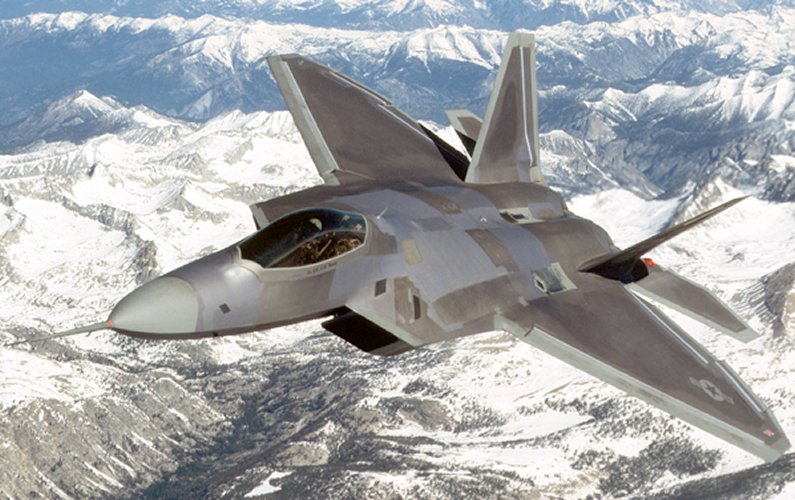
Victory for Gates and Obama on the F-22


The vote on Tuesday in the Senate to strip funding for extra F-22 fighters is a huge step in the fight for sanity in defense budgeting. The vote itself ended up being pretty one-sided, 58-40, but considering that its the first time in recent memory (certainly the last eight years) that a major military program has been cut over the objection of a large and influential group. This time Gates' lobbying over the last several weeks combined with Obama's threat to veto the entire bill if the funding was included were successful in getting the money removed.

However, as exciting as it is to have rationality coming back into play as a driver for defense budgeting is great, but this should only be the beginning. Now that the remarkably potent combination of Obama and Gates have managed this, future reforms seem not only desirable but actually possible. Each step is going to be difficult as defense contractors, their armies of lobbyists and their allies on the Hill line up to prevent cuts, but with a popular President and an extraordinarily skilled and respected SecDef, reform finally has a fighting chance. Combine that with the release of the QDR early in 2010 and the next 8-10 months are looking like they may fundamentally reshape how the military decides what it needs and how it goes about getting it. It's about time.

Tuesday, June 9, 2009

Social networks around the globe

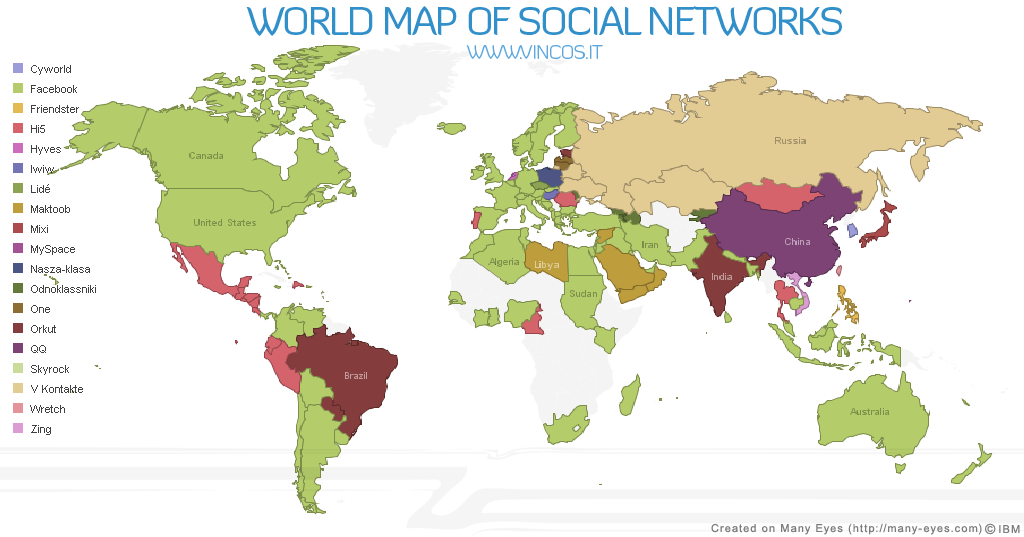
Interesting map (h/t Sullivan) showing which social networking sites are popular around the world. Facebook is easily the most dominant (not bad for something started in a Harvard dormroom) while MySpace has taken a serious hit and ranks first nowhere. Also interesting to see that Brazil and India share a site. I'm not sure how much this kind of stuff actually matters except as something fun to know but it's noteworthy that the places where Facebook has dominated seems to those places that get the vast majority of gap year and student travelers. Where those people like to go, i.e. Australia, South America, Europe, Facebook has taken over.

NYT learns COIN

Yesterday's Times editorial discussed American policy for Afghanistan policy and specifically addressed the issue of metrics and how the United States should be evaluating the success or failure of that new policy over the next year. Now it's not perfect but the editorial displays an impressive level of understanding of the tenets of counterinsurgency that would have been unthinkable just a few years ago. Perhaps they read Abu M's new report! Wherever they got their insights, they're good ones and outline pretty much exactly what the US should be doing in terms of understanding whether the new strategy is working in Afghanistan.

Dept of Amazing Jobs

Repossession men tend to have a bad reputation, sneaking off with someone's car or forcing them to leave their house. But what about a repo man who takes airplanes and yachts--taking back the toys of the rich from their delinquent owners who aren't paying for their learjet? We can get behind him, particularly when he's been doing it for 20 years, has repo'd over 1300 airplanes and has landed in jail in Haiti and other less than lovable countries. Read the whole thing in Salon, it's a fantastic story--particularly the bit about the 240 helicopters....

Thursday, May 28, 2009

Bill Clinton NYT mag interview


Peter Baker has a long story/interview about Bill Clinton in this week's NYT  magazine. It's a interesting and fair-minded portrayal of the former president and seems to show that he's begun to accept life as a former president and that the effects of last year's campaign (where he seemed to run the risk of ruining his legacy in the eyes of many dems) are over. Instead, he's dedicated himself fully to his foundation, has stayed largely out of the public eye and, while he's never shy in front of the camera, doesn't seem to need the constant attention anymore.

One of the more interesting sections of the article is Clinton's self-criticism about his role in the financial crisis. While he does argue that many of the Republican's claims about his responsibility are insance, he does take responsiblity for the things he thinks he missed. In particular, he wishes he'd had more foresight on derivatives (though, I wonder who doesn't wish anyone had had more foresight there) and to a lesser extent regrets the repeal of the Glass-Stegal Act, though he argues if the SEC had done its job, that wouldn't have mattered as much. It's an interesting read and seems to capture the 42nd President very well.

Tuesday, May 26, 2009

Does Iran really want nuclear weapons?

Fareed Zakaria has an interesting opinion piece in Newsweek this week
arguing that the real powers-that-be in Iran have been fairly
anti-nuclear weapon for years and that reversing now could have
seriously repercussions for their religious legitimacy. This is largely
because in the past they've phrased anti-nuke rhetoric in extremely
Islamic language--language it's not easy just to forget or move past.
Check out this line from Iran's Supreme Leader, Ayatollah Ali Khameini, given in a sermon in 2004:
"developing, producing or stockpiling nuclear weapons is forbidden under Islam."
It's pretty tough language to walk back and, as Zakaria points out, it would be pretty odd for a regime that claims legitimacy based on its fidelity to Islam to want to develop nuclear weapons even as it argues that they are un-Islamic. Just on the face if it, it's pretty terrible PR, something Iranians have tended to be pretty good at.

Just by airing this viewpoint the article raises a fascinating point about the perspective most Americans approach this issue with. We are trained by the media, our own government and other external actors (no names given) to see the Iranian regime as a suicide cult of death merchants. It couldn't be farther from the truth but that narrative never gets challenged. Thus, while Zakaria's article will probably shock a lot of the America audience, the real surprise should be how uninformed the American people and officials are about Iran and its leadership.


Monday, May 25, 2009

Waterboarding transcripts

The Atlantic's Jonathan Bines somehow got a hold of the very, very top secret CIA's transcripts of Abu Zubayday's 83 waterboardings. They make for a hilarious read....personally, my favorite entries are 5 and 6:

5. You can’t do this! Show me the authorization for you to do this!

6. Wow. O.K., technically, you can do this. Although the quality of the legal work in these memos is shoddy at …